Hand Surgery · Direct-Pay Specialist Care
Find a Board-Certified Hand Surgeon Near You
Search hand and wrist specialists in your city for carpal tunnel, trigger finger, arthritis, and injuries. Compare profiles, see the price before you book, and skip the referral.
Enter your ZIP code to see hand surgeons near you, with prices and open times.
- Board-certified hand surgeons
- No referral required
- Price shown before you book
- In-person and virtual visits
The direct answer
What does a hand surgeon do?
A hand surgeon is a physician who diagnoses and treats problems of the hand, wrist, and forearm, including carpal tunnel syndrome, trigger finger, arthritis, tendon and nerve injuries, fractures, and cysts. Hand surgeons first train in orthopedic, plastic, or general surgery, then complete a hand surgery fellowship. Many conditions are treated without surgery. You can book one directly on Apptly Health without a referral.
Key facts at a glance
In a large general-population study, 14.4% of adults reported numbness, tingling, or pain in the fingers typical of carpal tunnel syndrome, and 3.8% had it confirmed on exam [2].
Women are three times more likely than men to develop carpal tunnel syndrome, and carpal tunnel release is one of the most common surgeries in the United States [1].
Trigger finger affects about 1 to 2% of the general population and is more common in people with diabetes [3].
Apptly Health lets you book a board-certified hand surgeon directly, with the price shown before you confirm.
Hand Surgeons you can book now
Hand Surgeons near 07102
Current provider listings are checked when you open this page.
- Checking current provider listings, visit fees and appointment options…
Physician listings, available appointments and visit fees are refreshed when you search. Availability and the final fee are confirmed on the booking page.
Provider availability, prices and appointment times are checked live. Confirm exact visit details when booking.
Why Apptly is different
Hand care without the gatekeeping
Your hands do almost everything for you, so numb fingers or a stiff thumb affect work, sleep, and simple tasks. Apptly Health lets you go straight to a board-certified hand surgeon, see the price, and book a time that fits around your day.
See how it works
- Physician-founded and physician-led marketplace
- Verify each listed hand surgeon's credentials and board certification
- Visit price shown before you book
- Choose any listed hand surgeon, with no network limits
- No referral needed, whether it is numbness, pain, or an injury
- Book online in minutes
- HIPAA-compliant platform for your records and X-rays
- Many hand surgeons offer virtual visits for follow-ups and results
Know when to get care
When should you see a hand surgeon?
Many hand problems start mild and slowly get worse. Seeing a specialist early often means simpler treatment. Consider booking if any of these sound like you.
Symptoms worth a hand evaluation
- Numbness or tingling in the thumb, index, and middle fingers, especially at night
- A finger that catches, clicks, or locks when you bend or straighten it
- Pain at the base of the thumb when pinching, gripping, or turning a key
- Pain on the thumb side of the wrist that worsens when lifting a baby or a pan
- A lump on the wrist or finger that is growing or painful
- Weakness, dropping things, or a fingertip that will not straighten
Situations that call for a hand specialist
- A wrist or finger injury that is still swollen or painful after a week or two
- A hand or wrist fracture seen on X-ray at urgent care
- Fingers slowly curling toward the palm and not fully straightening
- Hand symptoms that have not improved with a splint or rest
- Diabetes or thyroid disease with new hand stiffness or numbness
- You were told you need hand surgery and want a second opinion
Important: Go to the emergency room or call 911 for a cut with heavy bleeding that does not stop with firm pressure, a partly or fully cut-off finger, a finger that is cold, pale, or numb after an injury, an obviously bent or dislocated finger or wrist, a high-pressure injection injury from a paint or grease gun, or a hand that is rapidly swelling, red, and painful after a bite or puncture. These need emergency care, not an online booking.
Understand your options
How much does a hand surgeon cost without insurance?
The cost of a self-pay hand surgeon visit varies by physician, location, visit format, and the services you need. Apptly Health is designed to show the listed visit fee before you confirm a booking. Do not assume that tests, procedures, or follow-up services are included in that fee.
Questions to ask before booking
- Is this price for a new-patient visit or a follow-up?
- Does the visit include X-rays or an injection, or are those billed separately?
- Will a virtual appointment be appropriate for my concern?
- Can the provider supply a Good Faith Estimate for scheduled self-pay care?
- Can I use eligible HSA or FSA funds for the visit?
For scheduled care, patients who are uninsured or choose not to use insurance generally have rights to a Good Faith Estimate under federal rules. Ask about additional services and expected charges in advance.
If you have Medicare or Medicaid: check with the physician's office before you book. Program rules limit when an enrolled physician can accept direct payment for covered services, so whether a self-pay visit is possible depends on the physician and the service.
Your path to care
How Apptly Health works
Getting your hands looked at should be easy on your hands.
-
Step 1
Search by city, ZIP code, or symptom.
Find board-certified hand surgeons near you or available by video.
-
Step 2
Choose your hand surgeon.
Compare training, focus areas, languages, and open times.
-
Step 3
See the price before you book.
The visit fee is shown up front, so you know what the consult costs.
-
Step 4
Book online and be seen.
Appointment timing depends on real provider availability in your selected location.
Results, prices, and appointment availability depend on participating physicians in your area.
Expertise for your needs
Conditions a hand surgeon treats
Hand surgeons focus on one small, complex part of the body: bones, joints, tendons, nerves, and skin working together. These are the problems they see most.
Carpal tunnel syndrome
Pressure on the median nerve at the wrist causes numbness and tingling in the thumb and first fingers, often waking people at night. Symptoms usually start gradually and affect the dominant hand first [1]. Severe or untreated cases can weaken the muscles at the base of the thumb [1].
Trigger finger
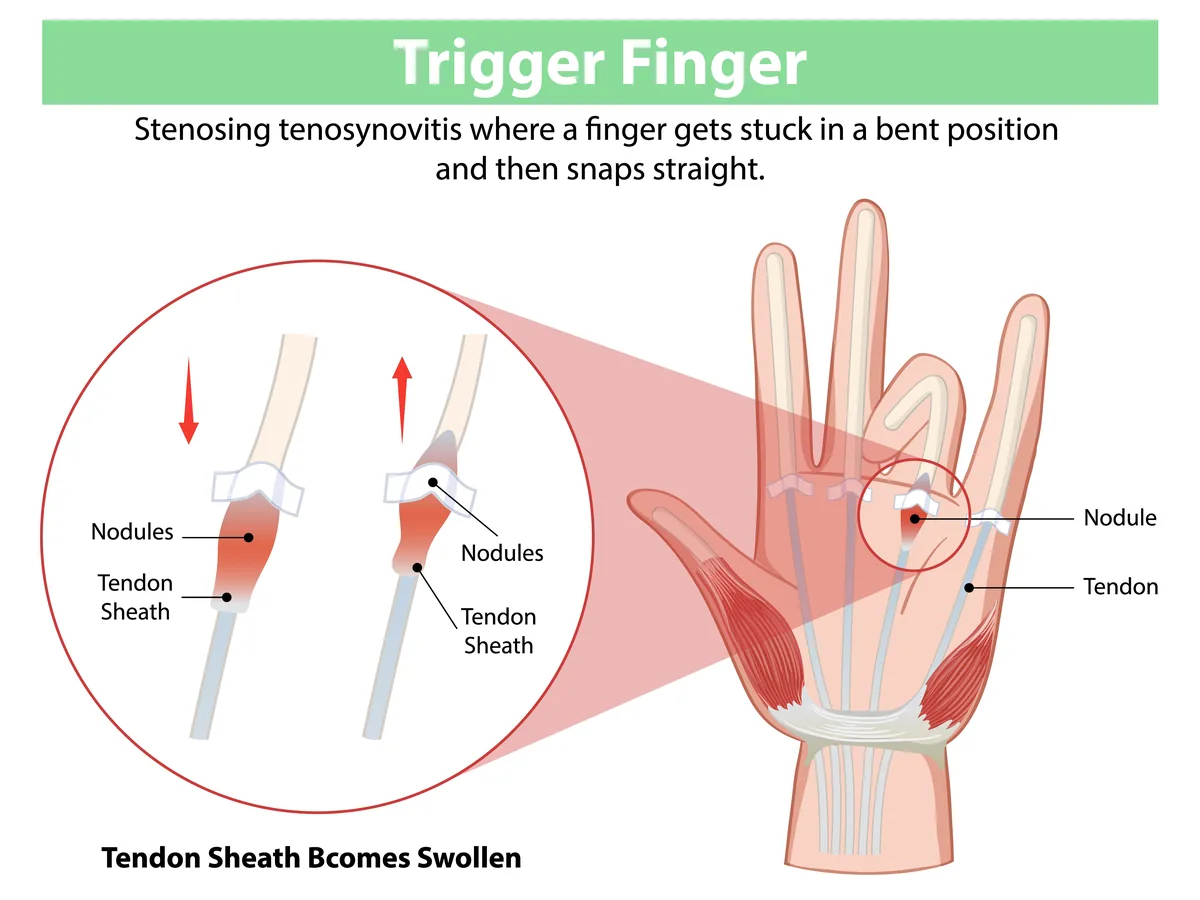
A thickened tendon sheath makes a finger catch or lock when it bends. It affects about 1 to 2% of people overall, and rates are higher in people with diabetes [3]. Splinting, a steroid injection, or a quick procedure to release the sheath are common options.
Thumb and wrist arthritis
Wear of the joint at the base of the thumb causes aching and weak pinch. Hand surgeons offer splints, hand therapy, injections, and, when those stop helping, surgery to rebuild the joint.
De Quervain's tendinitis and other tendon problems
Pain on the thumb side of the wrist is often de Quervain's tendinitis, common in new parents. Hand surgeons also repair torn tendons, including mallet finger, where the fingertip droops after a jammed finger.
Ganglion cysts and lumps
These fluid-filled lumps are usually harmless. A hand surgeon can confirm what a lump is, often with an exam and imaging, and discuss watching it, draining it, or removing it if it causes pain or limits movement.
Fractures, nerve injuries, and Dupuytren's contracture
Broken wrists and finger bones, cut nerves or tendons, and Dupuytren's disease, where fingers slowly pull toward the palm, all need a specialist's eye. Timing matters for injuries, so do not wait weeks to be seen.
Know your options
Treatments, from splints to surgery
Most hand problems are treated in steps, starting with the least invasive option likely to work. Your hand surgeon will explain which steps fit you.
Splinting and activity changes
For carpal tunnel syndrome, initial treatment is usually a splint worn at night, along with rest breaks and avoiding tasks that trigger symptoms [1]. Splints also help trigger finger, thumb arthritis, and tendinitis.
Injections
A corticosteroid injection can calm inflammation in carpal tunnel syndrome, trigger finger, and de Quervain's tendinitis. People with diabetes should discuss blood sugar effects with their surgeon first [1].
Hand therapy
Certified hand therapists use exercises, custom splints, and scar care to restore motion and strength, before or after surgery. Many hand surgeons work closely with them.
Surgery
When symptoms persist or nerves are at risk, surgery may help. Carpal tunnel release can be done through a small open incision or endoscopically; endoscopic release may allow faster functional recovery but carries a higher risk of complications [1]. Many hand procedures are done as outpatient surgery under local or regional anesthesia.
Before your appointment
What to expect at your first hand surgery visit
A first visit is usually quick and practical. Most people leave with a diagnosis and something to try right away.
Your story and your work.
Your hand surgeon asks when symptoms started, which fingers are involved, what you do for work and hobbies, and which is your dominant hand.
A hands-on exam.
Expect checks of feeling in each fingertip, grip and pinch strength, joint motion, and simple tests that press or tap over nerves to reproduce symptoms.
Imaging or nerve testing if needed.
X-rays are common for pain, arthritis, or injuries. For numbness, your surgeon may order a nerve conduction study, and sometimes an ultrasound or MRI.
A step-by-step plan.
You leave with a diagnosis, first-line treatment such as a splint or therapy, and pricing for any injections or procedures discussed.
Bring a list of medicines, any X-rays or nerve test results, and splints you already use. Note which activities make symptoms worse and whether they wake you at night. If you had an injury, bring the urgent care or ER paperwork. Wear short or loose sleeves so both forearms are easy to examine.
Make an informed choice
How to choose the right hand surgeon near you
Hand surgery is a true subspecialty, so training matters. This checklist will help you choose.
- Confirm board certification and ask about added hand training. The Subspecialty Certificate in Surgery of the Hand is offered jointly by the American Boards of Orthopaedic Surgery, Plastic Surgery, and Surgery and requires an accredited hand surgery fellowship [4]. You can verify any physician for free through the American Board of Medical Specialties [5].
- Match their background to your need. Orthopedic hand surgeons often focus on bones and joints; plastic surgery-trained hand surgeons often focus on soft tissue, nerves, and reconstruction. Both treat common problems like carpal tunnel.
- Ask how often they perform your procedure and whether they offer open or endoscopic options when relevant.
- Ask whether they work with certified hand therapists close to where you live or work.
- Look at the price before you book. Self-pay patients also have a federal right to a Good Faith Estimate of expected charges for scheduled care, including surgery [6].
- Check for virtual follow-ups, which save time during recovery.
The evidence
The evidence: hand problems are common
These figures come from the National Institute of Neurological Disorders and Stroke (NINDS) and peer-reviewed research.
-
14.4%
of adults reported carpal tunnel-type symptoms in the fingers
Numbness, tingling, or pain in the median nerve area, from a general-population study of 2,466 adults [2].
-
3.8%
had carpal tunnel syndrome confirmed on clinical exam
2.7% had it confirmed on both exam and nerve testing in the same study [2].
-
3x
more likely in women than men
Carpal tunnel syndrome usually occurs only in adults, and recurrence after treatment is rare [1].
-
1 to 2%
of people develop trigger finger
Rates are higher in people with diabetes, ranging from 1.5% to 20% depending on the group studied [3].
Go deeper
Recovery after carpal tunnel and other hand surgery
Recovery depends on the procedure and on your job. These are general expectations; your surgeon will give you a plan for your own hand.
The first days
Keep your hand raised above your heart to limit swelling and move your fingers gently as instructed. Most minor hand procedures are done as outpatient surgery, so you go home the same day.
The first weeks
Light daily tasks usually return first. Grip strength often drops after carpal tunnel release and then gradually improves [1]. Stitches are typically removed at a follow-up visit, which some surgeons handle by video when appropriate.
Getting back to full use
Full recovery after carpal tunnel release can take months [1]. Heavy gripping, manual labor, and some sports may take longer than desk work. Hand therapy can speed things up after more complex surgery.
Setting realistic expectations
Numbness that has been present for a long time may not fully go away, and less than half of people say their hands feel completely normal after carpal tunnel surgery [1]. Seeing a hand surgeon earlier gives the nerve its best chance.
Direct access compared
A simpler path to a hand specialist
| Consideration | Apptly Health | Traditional route |
|---|---|---|
| Referral | Not required | Often required, sometimes via a general orthopedist first |
| Getting a first visit | Varies by live provider availability | Wait times vary and can stretch for weeks |
| Price of the visit | Shown before you book | Known after the claim is processed |
| Choice of specialist | Any listed hand surgeon | Limited to your network |
| Follow-ups | In person or virtual | Mostly in person |
Related care
Related specialists you can book
Hand and wrist problems often overlap with other areas of care. These Apptly Health specialists frequently work alongside hand surgeons.
Helpful answers
Hand surgery questions, answered
Do I need a referral to see a hand surgeon?
Not on Apptly Health. You can book a board-certified hand surgeon directly without a referral from a primary care physician or orthopedist. If you plan to use insurance for surgery or therapy elsewhere, check your plan, because many HMO plans require a referral for in-network specialist care.
How much does a hand surgeon visit cost without insurance?
Each hand surgeon sets their own visit fee, and it is shown on their Apptly Health profile before you book. X-rays, nerve testing, injections, therapy, and surgery are priced separately. As a self-pay patient you are entitled to a Good Faith Estimate for scheduled services under the No Surprises Act.
Does Apptly Health bill my insurance?
No. Apptly Health is a direct-pay platform. You pay the hand surgeon's listed fee directly, and Apptly Health does not submit claims to your insurance. Some plans reimburse out-of-network care, so check with your insurer if you plan to request reimbursement.
Can I book a hand surgeon on Apptly Health if I have Medicare or Medicaid?
Check with the physician's office before you book. Medicare and Medicaid have rules that limit when an enrolled physician can accept direct payment for covered services, so whether a self-pay visit is possible depends on the physician and the service you need.
What is the difference between a hand surgeon and an orthopedic surgeon?
Orthopedic surgeons treat bones and joints throughout the body. A hand surgeon has completed extra fellowship training focused only on the hand, wrist, and forearm, and may come from orthopedic, plastic, or general surgery. For carpal tunnel, trigger finger, tendon or nerve injuries, or complex hand fractures, a hand surgeon is usually the more specific choice.
Do I need surgery for carpal tunnel syndrome?
Not always. Many people improve with a night splint, activity changes, and sometimes a steroid injection. Surgery is usually considered when symptoms are constant, last despite treatment, or come with weakness or muscle loss at the base of the thumb. A hand surgeon can help you decide.
Can I see a hand surgeon virtually?
Yes, for some visits. Video works well for reviewing X-rays and nerve tests, discussing treatment options, and checking recovery after surgery. A first visit usually needs an in-person exam to test feeling and strength, and your hand surgeon will tell you if you need to come in.
Is a hand doctor the same as a hand surgeon?
Usually, yes. People often search for a hand doctor when they mean a hand surgeon, the physician with specialized hand training. Hand surgeons treat many problems without an operation, so seeing one does not mean you will have surgery.
How do I know if a hand surgeon is board-certified?
Every hand surgeon on Apptly Health is verified as board-certified before their profile goes live. You can also check any physician for free through the American Board of Medical Specialties verification tool and look for the Subspecialty Certificate in Surgery of the Hand.
What should I bring to my first hand surgery appointment?
Bring a list of medicines, any X-rays, MRI, or nerve conduction results, splints you use, and urgent care paperwork if you were injured. Note which fingers are affected, what makes symptoms worse, and whether they wake you at night.
When is a hand injury an emergency?
Go to the ER or call 911 for heavy bleeding that will not stop with pressure, a cut-off fingertip or finger, a finger that is cold, pale, or numb, an obvious deformity, a high-pressure injection injury, or fast-spreading redness and swelling after a bite. Do not book an appointment for these.
Can I use HSA or FSA funds for a hand surgeon visit?
In many cases, yes. Visits to a physician for diagnosis or treatment, and medically necessary procedures and splints, are generally qualified medical expenses. Confirm with your plan administrator before you book, and keep your receipts.
More questions about booking, payments, or your account? Visit the Apptly Health FAQ page.

For physicians
Are you a hand surgeon?
Reach direct-pay patients who are actively looking for help with carpal tunnel, trigger finger, arthritis, and hand injuries. Set your own schedule and visit price, and spend less time on referrals and paperwork.
Apply to Join the NetworkMedical review and references
Medically reviewed by Dr. Paula Muto
Board-certified vascular surgeon and founder of Apptly Health
This page is for general information and does not replace a consultation with a qualified physician. If you think you are having a medical emergency, call 911. If you are in emotional crisis, call or text 988.