Vascular Surgery · Direct-Pay Specialist Care
Find a Board-Certified Vascular Surgeon Near You
See a vein and artery specialist for leg pain when walking, varicose veins, swelling, or an aneurysm. Compare profiles, see the price first, and book without a referral.
Enter your ZIP code to see vascular surgeons near you, with prices and open times.
- Board-certified vascular surgeons
- No referral required
- Price shown before you book
- In-person and virtual visits
The direct answer
What does a vascular surgeon do?
A vascular surgeon is a physician who diagnoses and treats diseases of the arteries, veins, and lymphatic vessels everywhere in the body except the heart and brain. That includes peripheral artery disease, carotid artery narrowing, aortic aneurysms, blood clots, and varicose veins. Vascular surgeons offer medication, exercise therapy, minimally invasive procedures, and open surgery, and many patients never need an operation.
Key facts at a glance
Nearly 10 million people age 40 and older in the United States have peripheral artery disease [2].
As many as 900,000 people in the U.S. may be affected by blood clots in the veins each year, and 60,000 to 100,000 die [3].
When an abdominal aortic aneurysm ruptures, the risk of death is as high as 81% [4].
Apptly Health lets you book a board-certified vascular surgeon directly, with the price shown before you confirm.
Vascular Surgeons you can book now
Vascular Surgeons near 07102
Current provider listings are checked when you open this page.
- Checking current provider listings, visit fees and appointment options…
Physician listings, available appointments and visit fees are refreshed when you search. Availability and the final fee are confirmed on the booking page.
Provider availability, prices and appointment times are checked live. Confirm exact visit details when booking.
Why Apptly is different
Vein and artery care without the gatekeeping
Circulation problems tend to creep up slowly, and it is easy to blame leg pain on age or swollen veins on standing too long. Apptly Health lets you go straight to a vascular specialist, see the cost, and get a clear answer.
See how it works
- Physician-founded and physician-led marketplace
- Verify each listed vascular surgeon's credentials and board certification
- The visit price is shown before you book
- No referral needed
- Choose any listed vascular surgeon, with no network limits
- Book online in minutes
- HIPAA-compliant platform
- Many vascular surgeons offer video visits for results and follow-ups
Know when to get care
When should you see a vascular surgeon?
You do not need to wait until a problem is severe. A vascular surgeon can confirm what is going on with simple, painless tests and help you decide how far treatment needs to go.
Symptoms worth a vascular evaluation
- Cramping, aching, or tiredness in the calves, thighs, or buttocks when you walk that eases when you stop
- Foot pain at rest, especially at night [6]
- A sore on a toe or foot that is slow to heal or not healing at all [6]
- A foot or lower leg that feels colder or looks paler than the other side
- Bulging, twisted, aching, or itchy veins in the legs
- Leg swelling, heaviness, or skin darkening around the ankles
Situations that justify a check-up
- You are a man age 65 to 75 who has ever smoked, the group advised to get a one-time aortic ultrasound [4]
- An ultrasound or CT scan found an aneurysm or narrowed artery
- Your doctor heard a whooshing sound over a neck artery
- You have had a blood clot in a leg or lung and still have symptoms
- You have diabetes, smoke, or have kidney disease along with leg or foot symptoms
- A parent or sibling had an aortic aneurysm
Important: Call 911 for sudden face drooping, arm weakness, or slurred speech (signs of stroke), sudden severe belly or back pain with dizziness (a possible ruptured aneurysm), sudden shortness of breath or chest pain (a possible clot in the lungs), or a leg that suddenly turns cold, pale, numb, and painful. These are emergencies and need immediate care, not an online booking.
Understand your options
How much does a vascular surgeon cost without insurance?
The cost of a self-pay vascular surgeon visit varies by physician, location, visit format, and the services you need. Apptly Health is designed to show the listed visit fee before you confirm a booking. Do not assume that tests, procedures, or follow-up services are included in that fee.
Questions to ask before booking
- Is this price for a new-patient visit or a follow-up?
- Does the visit include a vascular ultrasound, or is that billed separately?
- Will a virtual appointment be appropriate for my concern?
- Can the provider supply a Good Faith Estimate for scheduled self-pay care?
- Can I use eligible HSA or FSA funds for the visit?
For scheduled care, patients who are uninsured or choose not to use insurance generally have rights to a Good Faith Estimate under federal rules. Ask about additional services and expected charges in advance.
If you have Medicare or Medicaid: check with the physician's office before you book. Program rules limit when an enrolled physician can accept direct payment for covered services, so whether a self-pay visit is possible depends on the physician and the service.
Your path to care
How Apptly Health works
Getting to a vein and artery specialist should be simple.
-
Step 1
Search by city, ZIP code, or concern.
Find board-certified vascular surgeons near you or available by video.
-
Step 2
Compare surgeons.
Review credentials, focus areas, languages, and open times.
-
Step 3
See the price first.
The visit fee is shown up front, before you commit.
-
Step 4
Book and be seen.
Appointment timing depends on real provider availability in your selected location.
Results, prices, and appointment availability depend on participating physicians in your area.
Expertise for your needs
Conditions a vascular surgeon treats
Vascular surgeons care for blood vessels from the neck to the toes. These are the conditions people most often book them for.
Peripheral artery disease (PAD)
Plaque narrows the arteries to the legs, so muscles get less blood during activity. Early treatment focuses on walking programs, quitting smoking, and medication to lower heart attack and stroke risk. When symptoms limit your life or wounds appear, angioplasty, stents, atherectomy, or bypass can restore blood flow [6].
Abdominal aortic aneurysm
An aneurysm is a weak, bulging spot in the main artery in your belly. Most cause no symptoms. Small ones are watched with periodic ultrasound, since the yearly rupture risk is near zero below 4 cm but about 11% at 5.0 to 5.9 cm [4]. Larger ones are repaired with a stent graft or open surgery.
Carotid artery disease
Plaque in the neck arteries can break off and cause a stroke. A vascular surgeon uses ultrasound to measure narrowing and weighs medication alone against carotid surgery or stenting, based on how narrow the artery is and whether you have had symptoms.
Varicose veins and chronic venous insufficiency
Varicose veins are reported in up to 30% of the general population [5]. When valves in leg veins stop working, blood pools and causes aching, swelling, and skin changes. Compression stockings help many people, and sclerotherapy or catheter-based laser or radiofrequency ablation can close the faulty veins [5].
Deep vein thrombosis and post-clot problems
Blood thinners are the first treatment for most leg clots. Among people who have had a DVT, one third to one half develop long-term swelling, pain, or skin changes known as post-thrombotic syndrome [3]. A vascular surgeon can help when symptoms linger or a vein stays blocked.
Dialysis access and wound care
Vascular surgeons create the fistulas and grafts that people on hemodialysis need, and they work with wound specialists when poor circulation keeps a foot ulcer from healing.
Know your options
Treatment options, from walking plans to surgery
Vascular surgeons are trained in medical treatment, minimally invasive procedures, and open operations, so they can recommend whatever fits your situation best [1].
Medical management
Medication for cholesterol, blood pressure, clotting, and blood sugar, plus help quitting smoking, forms the base of care for almost every artery problem.
Supervised exercise
A structured walking program can noticeably increase how far people with PAD walk before pain starts. Many vascular practices can arrange one.
Vein procedures
Sclerotherapy injections, thermal ablation, and other office-based procedures treat varicose and spider veins, usually with local numbing and a quick return to normal activity.
Endovascular procedures
Through a small puncture, usually in the groin, a surgeon guides balloons, stents, or stent grafts inside the blood vessel using X-ray imaging. Recovery is often days rather than weeks.
Open surgery
Bypass grafts, carotid endarterectomy, and open aneurysm repair remain the best choice for some patients and can last a long time. Your surgeon will explain why one approach suits you over another.
Before your appointment
What to expect at your first vascular visit
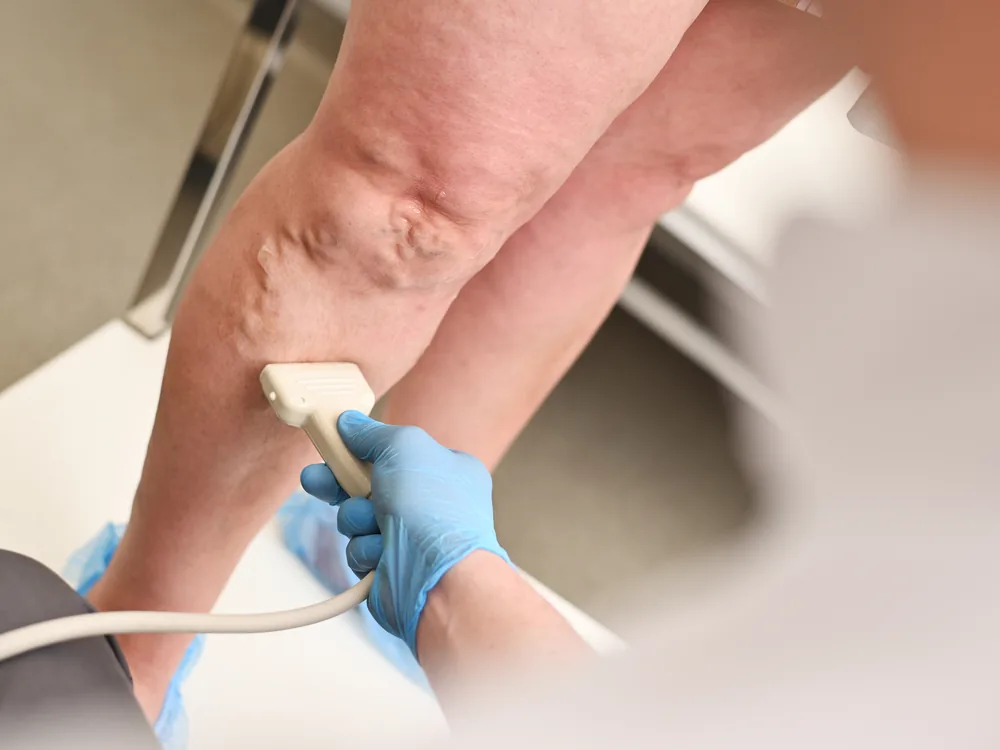
Most first visits combine a conversation, a hands-on exam, and simple ultrasound testing that does not hurt.
History and risk review.
Your surgeon asks where and when you have pain, how far you can walk, past clots or procedures, smoking history, and conditions like diabetes.
Physical exam.
Expect pulse checks in your feet and neck, a look at your legs and feet for swelling, color, or wounds, and a check of visible veins while you stand.
Noninvasive testing.
An ankle-brachial index compares blood pressure in your ankles and arms. Duplex ultrasound shows blood flow and vein valve function. Both are painless.
A clear plan.
You leave knowing your diagnosis, whether you need treatment now or monitoring, and pricing for any follow-up services discussed.
Bring a list of medications, especially blood thinners, any prior ultrasound or CT reports, and the dates of past clots or vascular procedures. Wear loose pants or shorts so your legs are easy to examine, and bring your compression stockings if you use them.
Make an informed choice
How to choose the right vascular surgeon near you
Look for the right training, honest advice about whether you need a procedure at all, and a surgeon who explains trade-offs clearly. Use this checklist.
- Confirm board certification. You can verify any physician for free through the American Board of Medical Specialties [7]. Every vascular surgeon on Apptly Health is verified before listing.
- Ask whether the surgeon offers both endovascular and open options, so the choice is about you rather than the tools on hand.
- For vein treatment, ask whether a duplex ultrasound will be done first to map which veins are causing symptoms.
- Check hospital affiliations and whether the practice has its own accredited vascular lab.
- Compare availability, including video visits for reviewing results.
- See the price before you book. Self-pay patients also have a federal right to a Good Faith Estimate of expected charges for scheduled care [8].
- Read the profile for languages spoken and areas of focus such as veins, PAD, aortic disease, or dialysis access.
The evidence
The evidence: why vascular disease deserves attention
Many vascular conditions cause no symptoms until something serious happens. These figures come from federal health agencies and national guidelines.
-
~10 million
Americans age 40 and older have peripheral artery disease
The National Heart, Lung, and Blood Institute estimates nearly 10 million people in this age group are affected [2].
-
900,000
people may be affected by venous blood clots each year
About one third of people with a blood clot in a vein will have another within 10 years [3].
-
81%
risk of death when an aortic aneurysm ruptures
This is why a one-time ultrasound is recommended for men 65 to 75 who have ever smoked [4].
-
Up to 30%
of the general population has varicose veins
Long-term studies found about 23% of men and 30% of women developed varicose veins [5].
Go deeper
Vascular surgeon, interventional radiologist, or cardiologist?
These three specialists overlap, which can make it hard to know where to start. Here is a plain-language guide.
Vascular surgeon
Treats arteries and veins outside the heart and brain, and can offer medication, minimally invasive procedures, and open surgery. A strong first stop for leg pain when walking, aneurysms, carotid disease, non-healing foot wounds, and vein problems.
Interventional radiologist
Performs image-guided procedures through a needle or small tube, such as vein ablation, clot removal, and stenting, but does not perform open surgery. A good option when a specific minimally invasive procedure is already being considered.
Cardiologist
Focuses on the heart itself, including chest pain, rhythm problems, and heart failure. People with PAD often see a cardiologist too, because artery plaque in the legs usually means plaque elsewhere.
A note on the term cardiovascular surgeon
People often search for a cardiovascular surgeon when they mean a vascular surgeon. Surgeons who operate on the heart itself are cardiothoracic surgeons. For leg arteries, veins, the aorta in the belly, and neck arteries, a vascular surgeon is usually the right choice.
Direct access compared
A more direct path to vascular care
| Consideration | Apptly Health | Traditional route |
|---|---|---|
| Referral | Not required | Often required by your plan |
| Choice of surgeon | Any listed vascular surgeon | Limited to your network |
| Price | Shown before you book | Often unclear until the bill arrives |
| Scheduling | Online booking in minutes | Phone calls during office hours |
| Visit type | In person or virtual | Mostly in person |
Related care
Related specialists you can book
Circulation problems often involve more than one specialist. These Apptly Health specialists frequently work alongside vascular surgeons.
Helpful answers
Vascular surgery questions people ask most
Do I need a referral to see a vascular surgeon?
Not on Apptly Health. You can book a board-certified vascular surgeon directly, without a referral from your primary care doctor. If you plan to use insurance for other care, check your plan, because many HMO plans require a referral before they cover an in-network specialist visit.
How much does a vascular surgeon visit cost without insurance?
Each vascular surgeon sets their own visit price, and it appears on their Apptly Health profile before you book. Ultrasound testing and procedures are priced separately. As a self-pay patient you can also ask for a Good Faith Estimate for scheduled services under the No Surprises Act, which helps you plan for any treatment.
Does Apptly Health bill my insurance?
No. Apptly Health is a direct-pay platform. You pay the vascular surgeon's listed fee directly, and Apptly Health does not submit claims to your insurance. Some plans reimburse out-of-network care, so check with your insurer if you plan to request reimbursement.
Can I book a vascular surgeon on Apptly Health if I have Medicare or Medicaid?
Check with the physician's office before you book. Medicare and Medicaid have rules that limit when an enrolled physician can accept direct payment for covered services, so whether a self-pay visit is possible depends on the physician and the service you need.
Can I see a vascular surgeon virtually?
Yes, for many needs. Video visits work well for reviewing ultrasound or CT results, follow-up after a procedure, aneurysm monitoring plans, and medication questions. A first visit for leg pain, wounds, or varicose veins usually needs an in-person exam and pulse check, and your surgeon will tell you if so.
What is the difference between a vascular surgeon and an interventional radiologist?
Both perform minimally invasive procedures inside blood vessels. A vascular surgeon also manages vascular disease long term with medication and exercise, and can perform open surgery such as bypass or aneurysm repair. An interventional radiologist focuses on image-guided procedures and does not perform open operations. For an unexplained circulation problem, a vascular surgeon is a good place to start.
Is a vein doctor the same as a vascular surgeon?
Not always. Vascular surgeons treat veins and arteries and are board-certified in vascular surgery. Some vein clinics are run by doctors trained in other fields, such as interventional radiology or general surgery. Check the doctor's board certification and ask whether an ultrasound will map your veins before any treatment.
How do I know if a vascular surgeon is board-certified?
Every vascular surgeon on Apptly Health is verified as board-certified before their profile goes live. You can also confirm any physician's certification for free using the American Board of Medical Specialties verification tool. Vascular surgeons are certified by the American Board of Surgery.
What should I bring to my first vascular appointment?
Bring your medication list, especially any blood thinners, prior ultrasound or CT reports, and dates of past clots or vascular procedures. Note how far you can walk before pain starts and photos of any wounds over time. Wear loose clothing so your legs and feet are easy to examine.
Are varicose vein treatments covered or just cosmetic?
It depends on why you are being treated. Veins that cause aching, swelling, skin changes, or ulcers are a medical problem, and a duplex ultrasound documents the cause. Small spider veins treated only for looks are usually considered cosmetic. Your surgeon will explain which category applies to you and show the price before treatment.
When is leg pain an emergency?
Call 911 or go to the emergency room if a leg suddenly turns cold, pale, numb, or very painful, or if leg swelling comes with sudden shortness of breath or chest pain. These can mean a blocked artery or a clot that has traveled to the lungs. Pain only when walking that eases with rest is not an emergency, but it deserves a vascular visit.
Can I use HSA or FSA funds for a vascular surgery visit?
In many cases, yes. Visits to a physician for diagnosis or treatment are generally qualified medical expenses for HSA and FSA accounts. Purely cosmetic vein treatments, such as spider vein injections done only for appearance, may not qualify. Confirm with your plan administrator before you book.
More questions about booking, payments, or your account? Visit the Apptly Health FAQ page.
For physicians
Are you a vascular surgeon?
Reach direct-pay patients who are actively looking for vein and artery care. Set your own schedule and visit price, offer video follow-ups for imaging reviews, and spend less time on paperwork.
Apply to Join the NetworkMedical review and references
Medically reviewed by Dr. Paula Muto
Board-certified vascular surgeon and founder of Apptly Health
This page is for general information and does not replace a consultation with a qualified physician. If you think you are having a medical emergency, call 911. If you are in emotional crisis, call or text 988.