On this page
A first orthopedic visit is mostly a conversation and a careful look at the joint or area that’s bothering you. Knowing what happens, and coming prepared, helps you leave with clear answers instead of a list of things you forgot to ask.
This guide covers your first orthopedic visit from booking to the follow-up plan, with a checklist at the end you can print or keep on your phone. If you’re in Houston, you can browse participating orthopedic doctors in Houston and book directly.
Before the visit: booking and confirmation
On Apptly, you choose a participating orthopedic physician and request a time. The practice confirms your appointment, or suggests another time if that one has just filled. Once it’s confirmed, you’ll have the practice address and time in your confirmation.
If you’ve been seen in an ER or urgent care for the same problem, ask them for your discharge paperwork and imaging before the visit. It saves time on the day.
What to bring to an orthopedic appointment
The American Academy of Orthopaedic Surgeons recommends bringing a few specific things (AAOS OrthoInfo):
- A full medication list, including prescriptions, over-the-counter medicines, vitamins and herbal supplements.
- Your imaging and reports. If your X-rays or MRI were done elsewhere, bring the images and the radiologist’s report. For an outside MRI, bring a physical disc, because the surgeon may not be able to open images sent from another facility.
- A treatment timeline. What you’ve tried so far, such as medication, bracing, physical therapy or injections, how well each one worked and how long any relief lasted.
- Your health history, including conditions like diabetes or heart disease and any past problems with anesthesia.
- Your questions, written down so you don’t forget them.
Two practical additions: wear clothing that lets the doctor see and move the joint, such as shorts for a knee problem, and bring the shoes you wear most days if the problem is in your knee, ankle or foot.
What happens during the visit
Your history
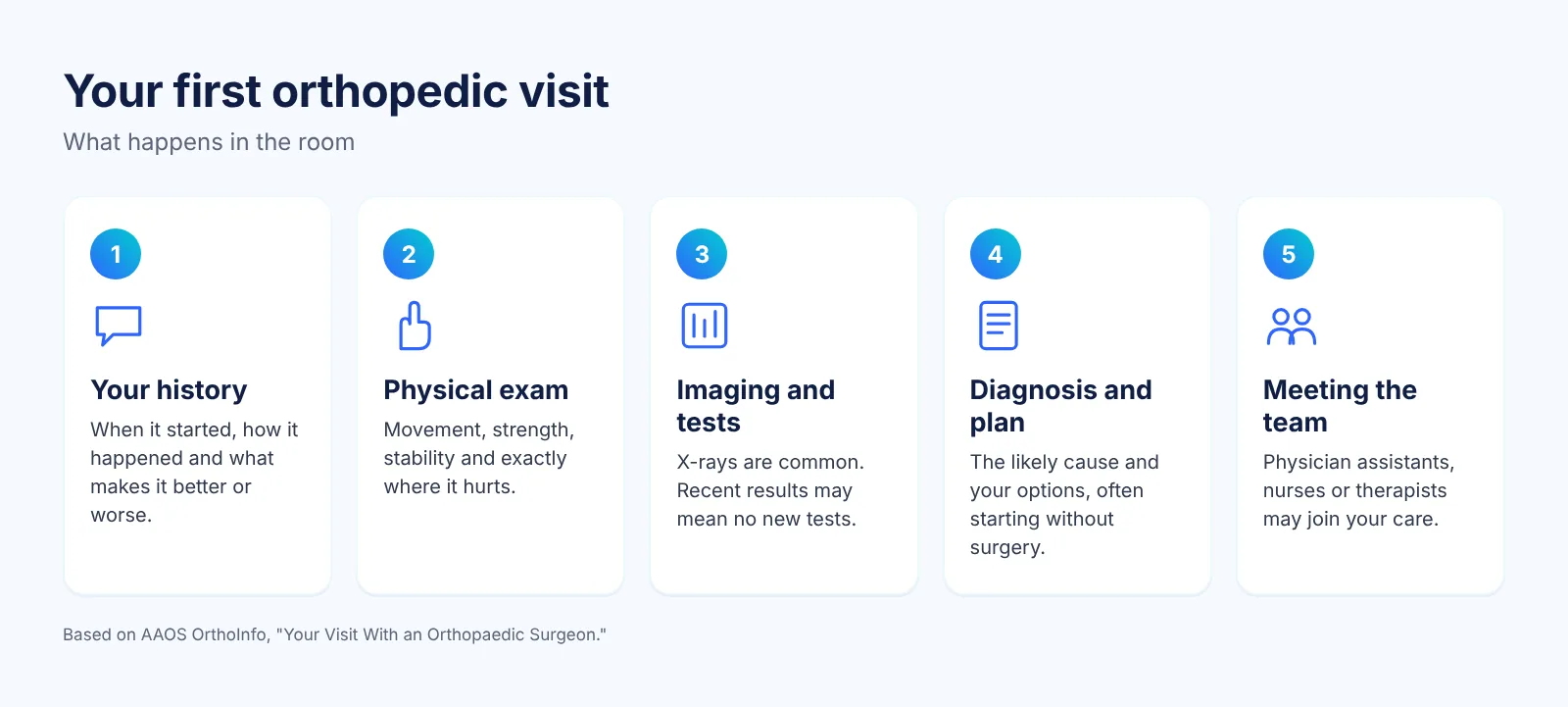
Expect questions about when the problem started, how it happened, what makes it better or worse, and how it affects your work, sleep and activity. This part matters more than most people expect, so be specific.
The physical exam
The doctor checks movement, strength, stability and exactly where it hurts, often comparing the painful side with the other one. Some tests may be a little uncomfortable. Say so if anything is sharply painful.
Imaging and tests
X-rays are common at a first orthopedic visit. An MRI or CT scan may be ordered if the exam and X-rays don’t fully answer the question. If you already have recent results the doctor can review, you may not need new tests, depending on how much time has passed and how complex the problem is (AAOS OrthoInfo).
Diagnosis and plan
You should leave knowing the likely diagnosis and your options. Many plans start without surgery: activity changes, physical therapy, a brace, medication or an injection. If another specialist would be a better fit, the doctor will tell you.
Meeting the team
Orthopedic practices often work as a team. You may meet a physician assistant, nurse or physical therapist alongside your doctor, with the surgeon leading your care (AAOS OrthoInfo).
Questions to ask an orthopedic doctor
Patients who ask questions and make sure they understand the answers tend to get more timely, accurate diagnoses (AHRQ). These are a good start:
- What do you think is causing this?
- What are my treatment options, and what does each one involve?
- What can I do at home, and what should I avoid?
- If you’re ordering a test, what will it show, and how will I get the results?
- What signs mean I should call you or come back sooner?
- When should I expect to feel better, and when do we follow up?
Keep asking until you understand the answer. If you’re worried about being able to follow the plan, because of work, travel or anything else, tell your doctor so it can be adjusted (AHRQ).
If surgery comes up
For some injuries and conditions, surgery is the right recommendation. It’s still worth taking the time to understand it. The American Academy of Orthopaedic Surgeons suggests asking (AAOS OrthoInfo):
- Why is the procedure recommended, and what are the other options?
- What happens if I delay or skip the surgery?
- How long will recovery take, and what activity limits will I have?
- Will I need help at home, and will physical therapy be part of recovery?
- Who can I see for a second opinion?
A second opinion before non-urgent surgery is common and reasonable, and most surgeons expect patients to consider one. You can book one with another orthopedic specialist on Apptly.
After the visit
- Follow-up. Ask when your next visit should be and book it before you leave, or request it through Apptly.
- Imaging and therapy. If the doctor orders an MRI or physical therapy, confirm where it will happen and how the results get back to your doctor.
- Records. Ask for a copy of your visit notes and imaging reports. They’re useful if you see another specialist later.
- Watch for changes. If symptoms get worse, call the practice. If you notice an emergency sign, such as numbness or discoloration in a finger or toe, or a limb that looks deformed, go to the emergency room (Mayo Clinic).
Your first orthopedic visit checklist
Screenshot this or download the printable checklist (PDF).
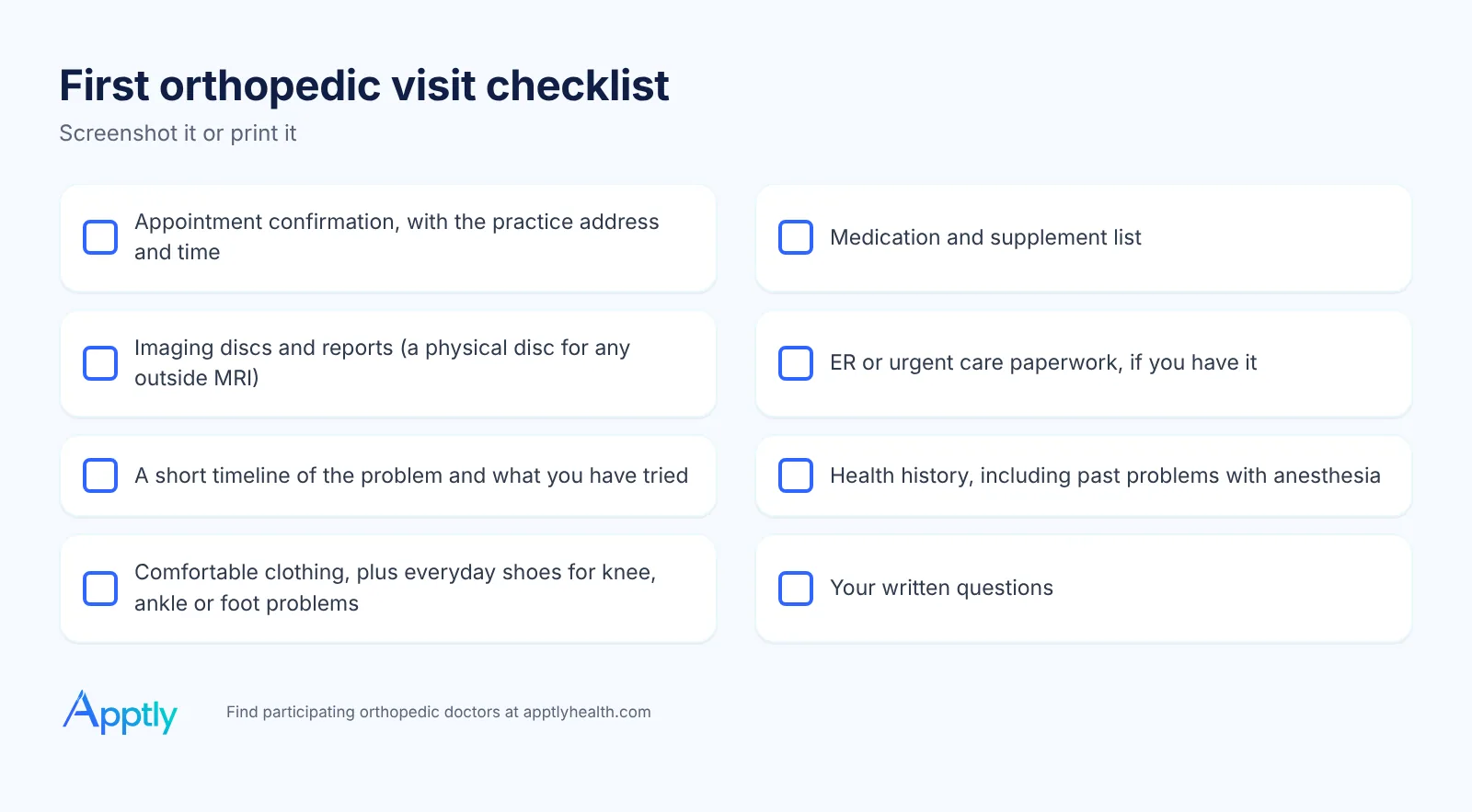
- Appointment confirmation, with the practice address and time
- Medication and supplement list
- Imaging discs and reports (a physical disc for any outside MRI)
- ER or urgent care paperwork, if you have it
- A short timeline of the problem and what you’ve tried
- Health history, including any past problems with anesthesia
- Comfortable clothing, plus your everyday shoes for knee, ankle or foot problems
- Your written questions
First orthopedic visit FAQs
How long does a first orthopedic appointment take?
It varies by practice and by whether X-rays are taken on the day. Plan for more time than a routine check-up, and ask the practice when they confirm your appointment.
Can I bring someone with me?
Yes, and it often helps. A family member or friend can take notes and remember details while you focus on the conversation.
Can I show my MRI on my phone?
Bring the disc and the written report as well. Images on a phone are hard to review in detail, and an orthopedic surgeon may not be able to open images sent from another facility (AAOS OrthoInfo).
What should I wear?
Loose clothing that lets the doctor see and move the joint. Shorts for a knee or hip problem, a short-sleeved top for a shoulder or elbow.
What if the doctor says I need a different specialist?
That’s a good outcome, not a wasted visit. Ask who they recommend and request a copy of your notes to take with you.
Ready to book your first visit?
Find a participating orthopedic physician who treats your problem and request a time that works for you. Apptly is launching city by city, starting with Houston.