Breast Surgery · Direct-Pay Specialist Care
Find a Board-Certified Breast Surgeon Near You
Found a lump or got a callback after your mammogram? Search breast surgeons near you, compare profiles and open times, and see the price before you book. No referral needed.
Enter your ZIP code to see breast surgeons near you, with prices and open times.
- Board-certified surgeons
- No referral required
- Price shown before you book
- Second opinions welcome
The direct answer
What does a breast surgeon do?
A breast surgeon is a surgeon who focuses on diagnosing and treating breast problems, from benign lumps and cysts to breast cancer. They evaluate abnormal mammograms, perform biopsies, lumpectomies, mastectomies, and lymph node surgery, and guide high-risk patients. Most are board-certified general surgeons, and some complete extra breast fellowship training. You can book one on Apptly Health without a referral.
Key facts at a glance
About 1 in 8 women in the U.S. will be diagnosed with breast cancer in her lifetime, and an estimated 321,910 new invasive cases are expected in 2026 [1].
When breast cancer is found while it is still localized, the 5-year relative survival rate is 100%, and 64% of cases are found at that stage [2].
Most breast lumps and changes are not cancer; as many as half of all women notice fibrocystic breast changes [5].
Apptly Health lets you book a board-certified breast surgeon directly, with the price shown before you confirm.
Breast Surgeons you can book now
Breast Surgeons near 07102
Current provider listings are checked when you open this page.
- Checking current provider listings, visit fees and appointment options…
Physician listings, available appointments and visit fees are refreshed when you search. Availability and the final fee are confirmed on the booking page.
Provider availability, prices and appointment times are checked live. Confirm exact visit details when booking.
Why Apptly is different
Breast care without the waiting game
The days between finding a lump and getting answers can feel endless. Apptly Health connects you directly with board-certified breast surgeons who set their own schedules and prices, so you can get to a plan sooner.
See how it works
- Physician-founded and physician-led marketplace
- Verify each listed breast surgeon's credentials and board certification
- The visit price is shown before you book
- Choose any listed breast surgeon, with no network limits
- No referral needed from your primary care doctor or OB-GYN
- Book online in minutes, including for a second opinion
- HIPAA-compliant platform for private results and conversations
- Many breast surgeons offer virtual visits to review imaging and pathology
Know when to get care
When should you see a breast surgeon?
Seeing a breast surgeon does not mean you need surgery. Many visits end with reassurance, a follow-up plan, or a simple office biopsy. Consider booking if any of these apply.
Breast changes worth a specialist look
- A new lump or thickening in the breast or underarm that does not go away after your next period
- Skin dimpling, puckering, redness, or an orange-peel texture
- A nipple that newly turns inward, or a scaly rash on the nipple
- Bloody or clear nipple discharge from one breast without squeezing
- Breast pain in one specific spot that does not come and go with your cycle
- Any lump in the breast or chest area in a man
Results and risk factors that call for a breast surgeon
- A mammogram or ultrasound read as suspicious, or a recommended biopsy
- A biopsy showing cancer, DCIS, or a high-risk lesion such as atypical hyperplasia
- A BRCA1, BRCA2, or other inherited gene change in you or a close relative
- A strong family history of breast or ovarian cancer
- Past chest radiation at a young age
- Wanting a second opinion before agreeing to surgery
Important: Seek urgent care or go to the emergency room if you have a hot, red, swollen, painful breast with fever and chills that is getting worse quickly, especially while breastfeeding, or heavy bleeding, spreading redness, or fever after breast surgery. Call 911 for trouble breathing, confusion, or fainting. These problems need same-day care, not an online booking.
Understand your options
How much does a breast surgeon cost without insurance?
The cost of a self-pay breast surgeon visit varies by physician, location, visit format, and the services you need. Apptly Health is designed to show the listed visit fee before you confirm a booking. Do not assume that tests, procedures, or follow-up services are included in that fee.
Questions to ask before booking
- Is this price for a new-patient visit or a follow-up?
- Is this fee for the consultation only, or does it include imaging review or a biopsy?
- Will a virtual appointment be appropriate for my concern?
- Can the provider supply a Good Faith Estimate for scheduled self-pay care?
- Can I use eligible HSA or FSA funds for the visit?
For scheduled care, patients who are uninsured or choose not to use insurance generally have rights to a Good Faith Estimate under federal rules. Ask about additional services and expected charges in advance.
If you have Medicare or Medicaid: check with the physician's office before you book. Program rules limit when an enrolled physician can accept direct payment for covered services, so whether a self-pay visit is possible depends on the physician and the service.
Your path to care
How Apptly Health works
Reaching a breast surgeon should not add stress.
-
Step 1
Search by city, ZIP code, or concern.
Find board-certified breast surgeons near you or available by video.
-
Step 2
Compare surgeons.
Review training, clinical interests, languages, and open times.
-
Step 3
See the price first.
The visit fee is shown up front, with no claim forms to file afterward.
-
Step 4
Book and be seen.
Appointment timing depends on real provider availability in your selected location.
Results, prices, and appointment availability depend on participating physicians in your area.
Expertise for your needs
Conditions a breast surgeon treats
Breast surgeons care for the full range of breast conditions. Much of their work is ruling cancer out and treating benign problems, not only operating on cancer.
Breast lumps and benign conditions
Most breast lumps and changes are not cancer [5]. Cysts are fluid-filled pockets, and fibroadenomas are firm, smooth, movable lumps most common in women under 30 [5]. A breast surgeon decides whether a lump needs imaging, a needle biopsy, removal, or simply follow-up.
Abnormal mammogram or ultrasound
A callback after screening is common and usually turns out to be benign. When imaging shows something suspicious, a breast surgeon reviews the images with you, explains what the findings mean, and arranges a biopsy if one is needed.
High-risk lesions and DCIS
Atypical hyperplasia and similar findings are not cancer but raise future risk. Ductal carcinoma in situ (DCIS) is an early, non-invasive form of breast cancer, with an estimated 60,730 cases expected in 2026 [1]. A breast surgeon explains your options, which may include surgery, close monitoring, or risk-lowering medicine.
Invasive breast cancer
For a new cancer diagnosis, the breast surgeon is often your first specialist. They plan surgery to the breast and lymph nodes and coordinate with medical oncologists, radiation oncologists, and plastic surgeons, who work together as one team [4].
Inherited high risk
About 50 in 100 women with a BRCA1 or BRCA2 gene change will develop breast cancer by age 70, compared with about 7 in 100 in the general population [6]. A breast surgeon can help you weigh enhanced screening, medicine, and risk-reducing surgery.
Know your options
Biopsies and surgeries a breast surgeon performs
Breast surgery today is often less extensive than people expect. Your surgeon will recommend options based on your diagnosis, imaging, and goals, and you have a voice in the choice.
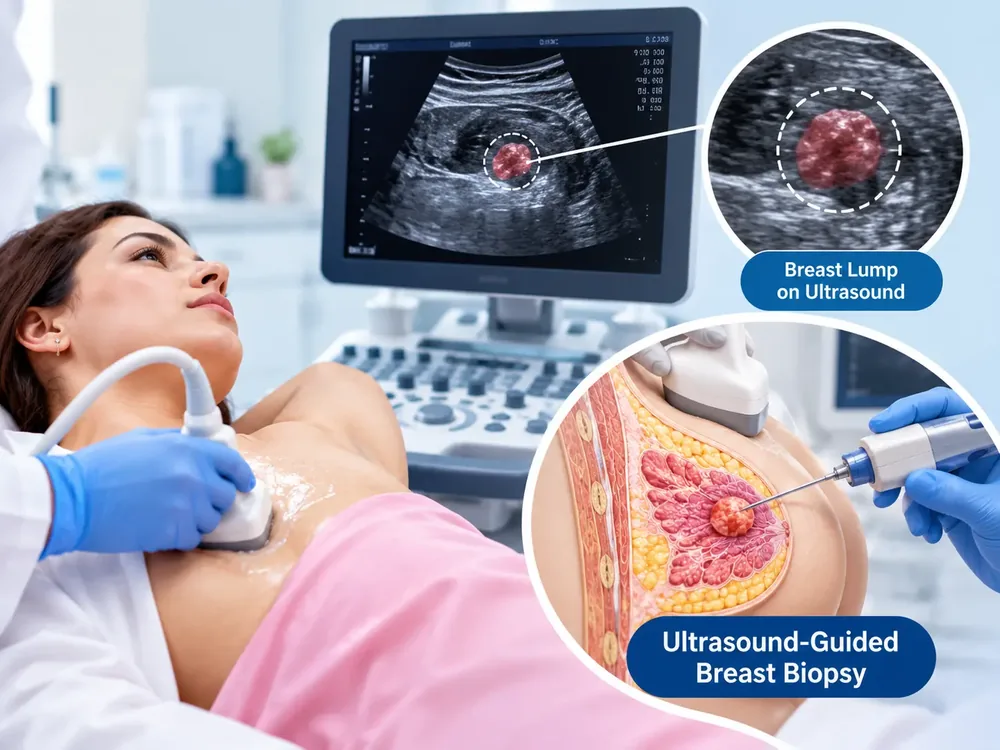
Needle biopsy
A core needle biopsy uses a hollow needle, often guided by ultrasound or mammogram, to remove small tissue samples. It is usually done with local numbing, and most people go back to normal activities the same day.
Lumpectomy
Also called breast-conserving surgery, a lumpectomy removes the tumor or lump with a rim of normal tissue and keeps the rest of the breast. For cancer it is usually followed by radiation.
Mastectomy
Removes the breast tissue. Some patients are candidates for skin-sparing or nipple-sparing techniques that help with reconstruction. A mastectomy may be recommended or chosen for larger tumors, multiple tumors, or inherited risk.
Lymph node surgery
A sentinel lymph node biopsy removes the first few nodes that drain the breast to check whether cancer has spread. It is less extensive than removing many nodes.
Risk-reducing surgery and reconstruction planning
For people at very high inherited risk, removing healthy breast tissue is one option to discuss. Breast surgeons work with plastic surgeons so reconstruction can be planned at the same time when that is the right choice.
Before your appointment
What to expect at your first breast surgeon visit
Most first visits are about getting clear information. Here is the usual flow.
Your story and history.
Your surgeon asks about the change you noticed, your cycle, past breast problems, hormone use, and family history of breast, ovarian, prostate, or pancreatic cancer.
A careful breast exam.
Expect an exam of both breasts and the lymph nodes in your underarms and neck. You can ask for a chaperone at any visit.
Imaging and pathology review.
Your surgeon reviews your mammogram, ultrasound, MRI, or biopsy report and may order more imaging or a biopsy.
A clear plan and next steps.
You leave knowing what the findings likely mean, what happens next, and the price of any follow-up visit before you book it.
Bring your imaging reports and images (on disc or by portal link), any biopsy pathology report, a list of medicines including hormones and blood thinners, and your family cancer history. A trusted person taking notes helps, especially after a new diagnosis.
Make an informed choice
How to choose the right breast surgeon near you
Look for strong training, a full care team, and clear explanations you trust. Use this checklist.
- Confirm board certification in surgery. There is no separate board certification for breast surgery; most breast surgeons are certified in general surgery, and some complete an extra one to two years of breast surgical oncology fellowship [4]. You can verify any surgeon's certification for free through the American Board of Medical Specialties [7]. Every surgeon on Apptly Health is verified before listing.
- Ask how much of their practice is breast surgery and whether they completed a breast fellowship.
- Ask whether they work with a multidisciplinary team, including medical oncology, radiation oncology, plastic surgery, and genetic counseling.
- Check hospital affiliations and where surgery would take place.
- Look at the visit price before you book. Self-pay patients also have a federal right to a Good Faith Estimate of expected charges for scheduled care [8].
- Choose someone who answers your questions fully and supports your right to a second opinion.
The evidence
The evidence: why prompt breast care matters
Breast cancer is common, and outcomes are strongly tied to how early it is found. These figures come from the National Cancer Institute, the American Cancer Society, and the CDC.
-
1 in 8
U.S. women will be diagnosed with breast cancer in her lifetime
The median age at diagnosis is 63, and an estimated 321,910 new invasive cases are expected in 2026 [1].
-
100%
5-year relative survival when breast cancer is found localized
64% of breast cancers are diagnosed at the localized stage, and overall 5-year relative survival is 91.9% [2].
-
50 in 100
women with a BRCA1 or BRCA2 gene change develop breast cancer by age 70
That compares with about 7 in 100 women in the general U.S. population [6].
-
Age 40
is when the USPSTF says screening mammograms should start
The task force recommends a mammogram every two years for women ages 40 to 74 [3].
Go deeper
From abnormal result to a plan: how the process usually works
Knowing the usual path can make an abnormal result feel less overwhelming. Your surgeon will tailor the steps to you.

Step 1: Diagnostic imaging
After a screening callback, you typically get a diagnostic mammogram and often a breast ultrasound. Many findings are cleared at this stage, and some are scheduled for a short-term follow-up.
Step 2: Biopsy if needed
If something still looks suspicious, a needle biopsy is the usual next step. Results often come back within a few days, and your surgeon or radiologist will go over them with you.
Step 3: Surgical consultation
If the biopsy shows cancer or a high-risk change, a breast surgeon explains your diagnosis and options. You may also be offered genetic counseling, especially with a strong family history [6].
Step 4: Team planning and a second opinion
For cancer, your surgeon coordinates with medical and radiation oncology, and some people start treatment with medicine before surgery. Taking time for a second opinion is reasonable for most diagnoses, and your surgeon can tell you how much time you have.
Direct access compared
A more direct path to a breast surgeon
| Consideration | Apptly Health | Traditional route |
|---|---|---|
| Referral | Not required | Often required by your plan |
| Who you can see | Any listed breast surgeon | Surgeons in your network |
| Price | Shown before you book | Known after the claim is processed |
| Second opinion | Book one directly | May need another referral |
| Visit type | In person or virtual | Mostly in person |
Related care
Related specialists you can book
Breast care is a team effort. These Apptly Health specialists often work alongside breast surgeons.
Helpful answers
Breast surgeon questions, answered
Do I need a referral to see a breast surgeon?
Not on Apptly Health. You can book a board-certified breast surgeon directly, without a referral from your primary care doctor or OB-GYN. If you plan to use insurance elsewhere, check your plan first, because many HMO plans require a referral for in-network specialist visits.
How much does a breast surgeon visit cost without insurance?
Each surgeon sets their own consultation price and shows it on their Apptly Health profile before you book. Imaging, biopsies, pathology, and surgery are priced separately. As a self-pay patient you can ask for a Good Faith Estimate of expected charges for scheduled care under the No Surprises Act.
Does Apptly Health bill my insurance?
No. Apptly Health is a direct-pay platform. You pay the breast surgeon's listed fee directly, and Apptly Health does not submit claims to your insurance. Some plans reimburse out-of-network care, so check with your insurer if you plan to request reimbursement.
Can I book a breast surgeon on Apptly Health if I have Medicare or Medicaid?
Check with the physician's office before you book. Medicare and Medicaid have rules that limit when an enrolled physician can accept direct payment for covered services, so whether a self-pay visit is possible depends on the physician and the service you need.
Can I see a breast surgeon virtually?
Yes, for some visits. Many breast surgeons on Apptly Health offer video visits to review imaging and biopsy results, discuss options, give a second opinion, or follow up after surgery. A new lump usually needs an in-person breast exam, and your surgeon will tell you when that is the case.
What is the difference between a breast surgeon and a plastic surgeon?
A breast surgeon diagnoses and removes breast disease, such as lumps and cancers, and performs biopsies, lumpectomies, mastectomies, and lymph node surgery. A plastic surgeon focuses on reconstruction after mastectomy and on cosmetic breast surgery. For cancer, the two often work together and may operate during the same surgery.
Is a breast surgeon board-certified in breast surgery?
There is no separate board certification for breast surgery. Most breast surgeons are board-certified in general surgery through the American Board of Surgery, and some complete an additional breast surgical oncology fellowship. You can confirm any surgeon's certification for free with the American Board of Medical Specialties Certification Matters tool.
What should I bring to my first breast surgeon appointment?
Bring your mammogram, ultrasound, or MRI reports and images, any biopsy pathology report, a list of medicines including hormones and blood thinners, and your family history of breast, ovarian, prostate, and pancreatic cancer. Writing your questions down ahead of time and bringing a support person both help.
Can I use HSA or FSA funds for a breast surgeon visit?
In many cases, yes. Visits to a physician for diagnosis or treatment, along with diagnostic imaging and biopsies, are generally qualified medical expenses. Cosmetic procedures usually are not. Confirm the details with your plan administrator before you book.
Does seeing a breast surgeon mean I have cancer?
No. Breast surgeons see many people with benign lumps, cysts, nipple discharge, and abnormal imaging that turns out to be harmless. Most breast lumps and changes are not cancer. Seeing a specialist simply means getting a clear answer from someone who evaluates breast problems every day.
Should I get a second opinion after a breast cancer diagnosis?
A second opinion is common and reasonable, especially when choosing between lumpectomy and mastectomy or considering risk-reducing surgery. Most breast cancers allow time to get one, but ask your surgeon how much time is safe in your situation.
When is a breast problem an emergency?
Get same-day care for a hot, red, swollen, painful breast with fever that is getting worse fast, or for heavy bleeding, spreading redness, or fever after breast surgery. Call 911 for trouble breathing, confusion, or fainting. A new painless lump is important but is not usually an emergency.
More questions about booking, payments, or your account? Visit the Apptly Health FAQ page.

For physicians
Are you a breast surgeon?
Reach direct-pay patients who are actively looking for breast care and second opinions, set your own schedule and price, and spend less time on administration.
Apply to Join the NetworkMedical review and references
Medically reviewed by Dr. Paula Muto
Board-certified vascular surgeon and founder of Apptly Health
This page is for general information and does not replace a consultation with a qualified physician. If you think you are having a medical emergency, call 911. If you are in emotional crisis, call or text 988.