General Surgery · Direct-Pay Specialist Care
Find a Board-Certified General Surgeon Near You
Search general surgeons in your city for hernias, gallbladder problems, and lumps or cysts. Compare profiles, see the consult price before you book, and skip the referral.
Enter your ZIP code to see general surgeons near you, with prices and open times.
- Board-certified general surgeons
- No referral required
- Price shown before you book
- Second opinions welcome
The direct answer
What does a general surgeon do?
A general surgeon is a physician trained to diagnose and operate on a wide range of conditions, most often in the abdomen. Common reasons to see one include hernias, gallbladder disease, appendicitis, lumps and cysts under the skin, and some intestinal problems. Many operations are now done through small incisions. You can book a board-certified general surgeon on Apptly Health without a referral.
Key facts at a glance
Gallstones affect 10 to 15 percent of the U.S. population, almost 25 million people [1].
About 27 percent of men and 3 percent of women will develop an inguinal (groin) hernia at some point in their lives [2].
About 5 to 9 of every 100 people develop appendicitis at some point, most often in their teens and 20s [3].
Apptly Health lets you book a board-certified general surgeon directly, with the consult price shown before you confirm.
General Surgeons you can book now
General Surgeons near 07102
Current provider listings are checked when you open this page.
- Checking current provider listings, visit fees and appointment options…
Physician listings, available appointments and visit fees are refreshed when you search. Availability and the final fee are confirmed on the booking page.
Provider availability, prices and appointment times are checked live. Confirm exact visit details when booking.
Why Apptly is different
Surgical consults without the gatekeeping
If you have a bulge in your groin or keep getting gallbladder attacks, you probably already suspect you need a surgeon. Apptly Health lets you skip the extra step and book a board-certified general surgeon directly, with the consult price shown first.
See how it works
- Physician-founded and physician-led marketplace
- Verify each listed general surgeon's credentials and board certification
- Consult price shown before you book
- Choose any listed general surgeon, with no network limits
- No referral needed for a surgical consultation
- Book online in minutes
- HIPAA-compliant platform for your records and imaging
- Many surgeons offer virtual visits for second opinions and post-op follow-up
Know when to get care
When should you see a general surgeon?
A consult does not commit you to surgery. It gives you a clear diagnosis and the full range of options, including whether watching and waiting is safe. Consider booking if any of these apply.
Signs that point to a surgical consult
- A bulge in the groin, belly button, or an old incision that appears when you stand, cough, or lift
- Pain under the right ribs after fatty meals, sometimes spreading to the back or right shoulder
- A lump under the skin that is growing, painful, or keeps getting infected
- A recurring abscess, boil, or pilonidal cyst near the tailbone
- Repeated bouts of diverticulitis or ongoing reflux that medicines no longer control
- Pain or pulling at the site of a hernia that limits work or exercise
Situations where a surgeon's opinion helps
- An ultrasound or CT scan showed gallstones, a hernia, or a mass
- Another doctor said you need an operation and you want a second opinion
- You want to understand open, laparoscopic, and robotic options before deciding
- You are planning surgery and want to know the price and recovery time up front
- You had an operation elsewhere and need a follow-up or wound check
- You were told to watch a small hernia and want to know when that changes
Important: Go to the emergency room or call 911 if a hernia bulge suddenly becomes larger, hard, or will not push back in, especially with severe pain, redness, fever, nausea, or vomiting. This can mean a strangulated hernia, which is life-threatening [2]. The same applies to severe belly pain that starts near the navel and moves to the lower right side, or right upper belly pain with fever or yellowing skin.
Understand your options
How much does a general surgeon cost without insurance?
The cost of a self-pay general surgeon visit varies by physician, location, visit format, and the services you need. Apptly Health is designed to show the listed visit fee before you confirm a booking. Do not assume that tests, procedures, or follow-up services are included in that fee.
Questions to ask before booking
- Is this price for a new-patient visit or a follow-up?
- Is this fee for the consultation only? Surgery, anesthesia, and facility fees are usually billed separately.
- Will a virtual appointment be appropriate for my concern?
- Can the provider supply a Good Faith Estimate for scheduled self-pay care?
- Can I use eligible HSA or FSA funds for the visit?
For scheduled care, patients who are uninsured or choose not to use insurance generally have rights to a Good Faith Estimate under federal rules. Ask about additional services and expected charges in advance.
If you have Medicare or Medicaid: check with the physician's office before you book. Program rules limit when an enrolled physician can accept direct payment for covered services, so whether a self-pay visit is possible depends on the physician and the service.
Your path to care
How Apptly Health works
Seeing a surgeon should not start with a paperwork maze.
-
Step 1
Search by city, ZIP code, or condition.
Find board-certified general surgeons near you or available by video.
-
Step 2
Choose your surgeon.
Compare credentials, procedures performed, languages, and open times.
-
Step 3
See the price before you book.
The consult fee is shown up front.
-
Step 4
Book online and be seen.
Appointment timing depends on real provider availability in your selected location.
Results, prices, and appointment availability depend on participating physicians in your area.
Expertise for your needs
Conditions a general surgeon treats
General surgery is broad. These are the problems that bring most adults to a general surgeon's office.
Hernias
A hernia happens when tissue pushes through a weak spot in the abdominal wall. Groin, belly button, and incisional hernias are the most common. Most people with inguinal hernias will need surgery to repair them, usually with mesh [2].
Gallstones and gallbladder disease
Most gallstones are silent and need no treatment [1]. When they cause attacks of pain, inflammation, or block a bile duct, surgeons usually recommend removing the gallbladder, most often laparoscopically. Untreated complications can include infection and gallstone pancreatitis [1].
Appendicitis
Appendicitis is the most common cause of sudden belly pain that needs surgery in the United States [3]. It is treated as urgent, usually with removal of the appendix, because an untreated appendix can burst.
Skin and soft tissue lumps
Lipomas, sebaceous cysts, recurring abscesses, and pilonidal disease are common reasons for a general surgery visit. Many are removed in the office or as a short outpatient procedure under local anesthesia.
Intestinal problems
General surgeons operate on the small intestine and colon for blockages, diverticulitis, and some cancers. For complex rectal and anal conditions, they may work with or refer to a colorectal surgeon.
Reflux and hiatal hernia
When severe reflux is caused by a hiatal hernia and does not respond to medicine, some general surgeons perform anti-reflux surgery that repairs the hernia and reinforces the valve at the bottom of the esophagus.
Know your options
Surgical approaches, explained simply
Your surgeon chooses an approach based on your condition, your health, and their experience. Knowing the options helps you ask good questions.
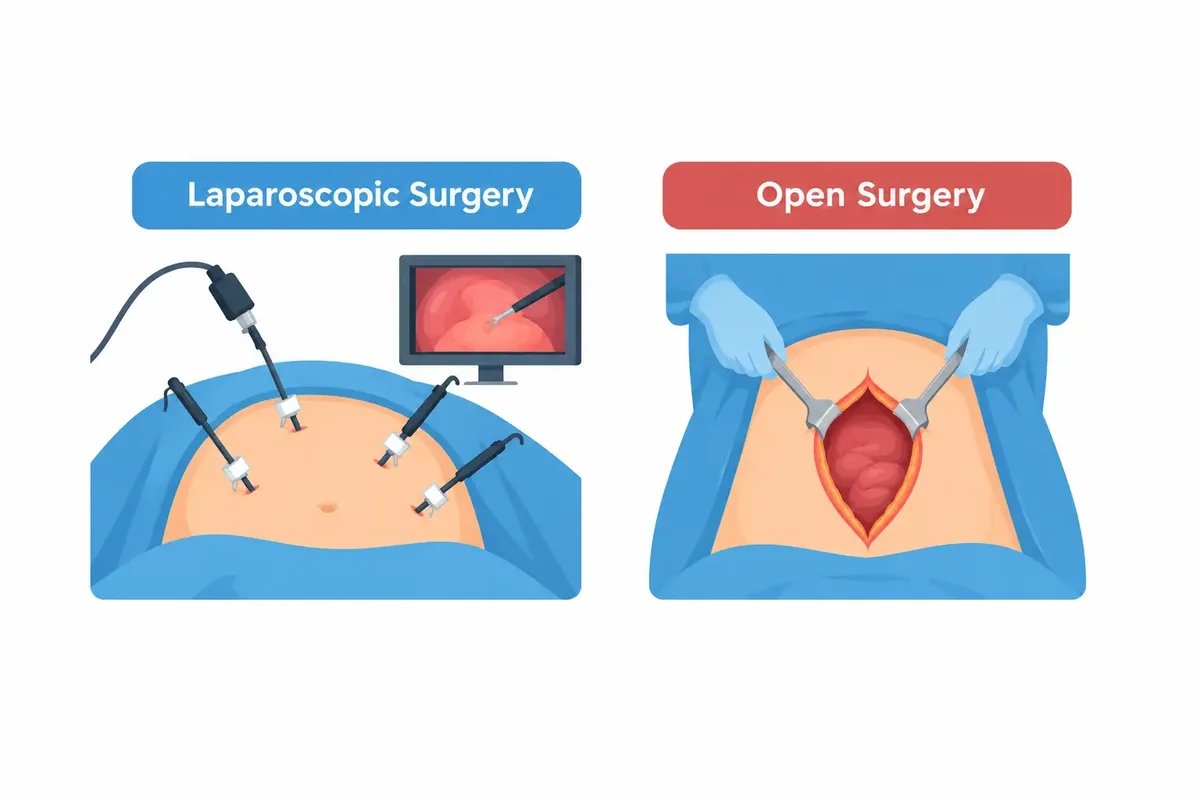
Laparoscopic surgery
The surgeon works through a few small incisions with a camera and slim instruments. It is common for gallbladder removal, appendectomy, and many hernia repairs, and often means less pain and a faster return to normal activity.
Robotic-assisted surgery
A form of minimally invasive surgery where the surgeon controls robotic instruments from a console. It can help with some hernia and intestinal operations. It is a tool, not automatically better, so ask why it would help in your case.
Open surgery
A single larger incision is still the right choice for some large hernias, emergencies, or patients with extensive scar tissue. Recovery usually takes longer.
Watchful waiting
Not every problem needs an operation right away. Men with inguinal hernias that cause few or no symptoms may be able to safely delay surgery, though roughly 7 in 10 end up needing it within 5 years [2].
Before your appointment
What to expect at your first surgical consultation
A surgical consult is mostly a conversation about whether, when, and how to operate. You are never committing to surgery by booking one.
Your history and goals.
Your surgeon reviews your symptoms, past operations, medicines, other health conditions, and what you want to get back to, such as work, lifting, or sports.
A focused exam.
For a hernia, the surgeon examines you standing and lying down, often asking you to cough. For other problems, they examine the specific area of concern.
Imaging and tests review.
Bring any ultrasound, CT, or lab results. The surgeon may order more imaging or pre-op testing if needed.
Options, risks, and price.
You leave understanding the surgical and non-surgical options, expected recovery, and pricing for any procedure discussed so you can decide without pressure.
Bring a list of medicines, especially blood thinners, diabetes medicines, and weight-loss injections, which may need to be paused before surgery. Bring imaging reports and discs, notes from past operations, and any questions about time off work, driving, or lifting limits.
Make an informed choice
How to choose the right general surgeon near you
The right surgeon has the training for your procedure, does it often, and is honest about whether you need surgery at all. Use this checklist.
- Confirm board certification. General surgeons are certified by the American Board of Surgery [4], and you can verify any physician for free through the American Board of Medical Specialties [5]. Every surgeon on Apptly Health is verified before listing.
- Ask how often they perform your specific operation and which approach they recommend for you, laparoscopic, robotic, or open.
- Ask where the surgery would take place, such as an outpatient surgery center or a hospital, and whether you would go home the same day.
- Ask what recovery looks like for your job and activities, and who to call after hours.
- Look at the price before you book. Self-pay patients also have a federal right to a Good Faith Estimate of expected charges for scheduled surgery, including facility and anesthesia fees [6].
- Feel free to get a second opinion. A good surgeon will welcome it.
The evidence
The evidence: common surgical problems by the numbers
These figures from the National Institute of Diabetes and Digestive and Kidney Diseases show how common the conditions behind most general surgery visits are.
-
25 million
people in the U.S. have gallstones
That is 10 to 15 percent of the population, though many never have symptoms [1].
-
27%
of men will develop an inguinal hernia in their lifetime
Compared with about 3 percent of women [2].
-
7 in 10
men who delay repair of a mild hernia need surgery within 5 years
Watchful waiting can be safe for low-symptom hernias, with regular check-ins [2].
-
5 to 9 in 100
people develop appendicitis at some point
It is most common in the teens and 20s but can happen at any age [3].
Go deeper
Getting ready for surgery and recovering well
Good preparation shortens recovery. These are general steps; your surgeon will tailor them to you.
Before surgery
If you smoke, stopping even a few weeks ahead helps wounds heal. Keep blood sugar in range if you have diabetes, ask which medicines to pause, and arrange a ride home and help for the first day or two.
The first week
After laparoscopic gallbladder or hernia surgery, many people go home the same day. Walking soon after surgery helps prevent clots and eases gas pain. Follow your surgeon's pain plan and lifting limits.
Getting back to normal
Desk work often resumes within a week or two after minimally invasive surgery, while heavy lifting may need several weeks. Open operations take longer. Your surgeon will give you clear timelines.
When to call your surgeon
Call for fever, increasing redness or drainage from a wound, worsening belly pain, vomiting, inability to pass gas or stool, or yellowing of the skin. For chest pain or trouble breathing, call 911.
Direct access compared
A simpler path to a surgical opinion
| Consideration | Apptly Health | Traditional route |
|---|---|---|
| Referral | Not required | Often required by your plan |
| Getting a consult | Varies by live provider availability | Wait times vary and can stretch for weeks |
| Consult price | Shown before you book | Known after the claim is processed |
| Choice of surgeon | Any listed general surgeon | Limited to your network |
| Second opinion | Book directly, in person or by video | May need another referral |
Related care
Related specialists you can book
Surgical problems often overlap with other specialties. These Apptly Health specialists frequently work alongside general surgeons.
Helpful answers
General surgery questions, answered
Do I need a referral to see a general surgeon?
Not on Apptly Health. You can book a board-certified general surgeon directly for a consultation without a referral from a primary care physician. If you plan to use insurance for the operation itself, check your plan first, because many HMO plans require a referral and prior authorization for surgery.
How much does a surgical consultation cost without insurance?
Each surgeon sets their own consult fee, and it is shown on their Apptly Health profile before you book. The operation, anesthesia, facility, and pathology fees are priced separately. As a self-pay patient you are entitled to a Good Faith Estimate for scheduled surgery under the No Surprises Act, and you can dispute a bill that comes in well above it.
Does Apptly Health bill my insurance?
No. Apptly Health is a direct-pay platform. You pay the general surgeon's listed fee directly, and Apptly Health does not submit claims to your insurance. Some plans reimburse out-of-network care, so check with your insurer if you plan to request reimbursement.
Can I book a general surgeon on Apptly Health if I have Medicare or Medicaid?
Check with the physician's office before you book. Medicare and Medicaid have rules that limit when an enrolled physician can accept direct payment for covered services, so whether a self-pay visit is possible depends on the physician and the service you need.
What is the difference between a general surgeon and a colorectal surgeon?
General surgeons are trained across many areas, including hernias, gallbladder disease, appendicitis, skin and soft tissue problems, and many intestinal operations. Colorectal surgeons complete extra training focused on the colon, rectum, and anus. For hemorrhoids, fissures, fistulas, or rectal cancer, a colorectal surgeon is often the better fit.
Does every hernia need surgery?
No. Men with inguinal hernias that cause few or no symptoms may be able to safely delay surgery with regular check-ins, although most eventually need repair. Hernias that hurt, grow, or limit activity usually should be fixed. A hernia that becomes stuck, hard, or very painful is an emergency.
Can I see a general surgeon virtually?
Yes, for some visits. Video works well for reviewing imaging, second opinions, discussing options, and post-op check-ins. Most new problems such as a hernia or lump need an in-person exam before surgery is planned, and your surgeon will tell you when to come in.
Do I need my gallbladder removed if I have gallstones?
Not always. Gallstones that cause no symptoms usually need no treatment. If you have repeated attacks of pain, inflammation, or a complication such as a blocked duct or pancreatitis, a surgeon will likely recommend removing the gallbladder. Most people digest food normally afterward.
How do I know if a general surgeon is board-certified?
Every surgeon on Apptly Health is verified as board-certified before their profile goes live. General surgeons are certified by the American Board of Surgery, and you can check any physician's status for free through the American Board of Medical Specialties verification tool.
What should I bring to my surgical consultation?
Bring a list of medicines and supplements, including blood thinners, diabetes medicines, and weight-loss injections, plus imaging reports and discs, recent lab work, and notes from past operations. Write down your questions about recovery, time off work, and lifting limits.
Is sudden belly pain an emergency?
It can be. Severe pain that starts near the navel and moves to the lower right side, right upper belly pain with fever or yellow skin, or a hernia that is hard and will not go back in all need emergency care. Call 911 or go to the ER rather than booking an appointment.
Can I use HSA or FSA funds for a surgical consult or surgery?
In many cases, yes. Visits to a physician for diagnosis or treatment and medically necessary surgery are generally qualified medical expenses. Confirm with your plan administrator before you book, and keep your Good Faith Estimate and receipts.
More questions about booking, payments, or your account? Visit the Apptly Health FAQ page.

For physicians
Are you a general surgeon?
Reach direct-pay patients who are actively looking for hernia, gallbladder, and soft tissue consults and second opinions. Set your own schedule and consult price, and spend less time chasing referrals and authorizations.
Apply to Join the NetworkMedical review and references
Medically reviewed by Dr. Paula Muto
Board-certified vascular surgeon and founder of Apptly Health
This page is for general information and does not replace a consultation with a qualified physician. If you think you are having a medical emergency, call 911. If you are in emotional crisis, call or text 988.