Dentistry · Direct-Pay Specialist Care
Find a Licensed Dentist Near You
Book a checkup, cleaning, or visit for tooth pain with a dentist in your area. Compare profiles and open times, and see the price before you book.
Enter your ZIP code to see dentists near you, with prices and open times.
- Licensed dentists, verified before listing
- No referral required
- Price shown before you book
- Care for adults and kids
The direct answer
What does a dentist do?
A dentist is a Doctor of Dental Surgery (DDS) or Doctor of Dental Medicine (DMD) licensed by the state to diagnose and treat problems of the teeth, gums, and mouth. General dentists provide checkups, cleanings, X-rays, fillings, crowns, root canals, and simple extractions, and they screen for gum disease and oral cancer. They refer to dental specialists, such as oral surgeons, for complex care.
Key facts at a glance
About 1 in 5 U.S. adults ages 20 to 64 (21%) has at least one untreated cavity [1].
About 42% of adults age 30 and older have some form of periodontitis (gum disease) [2].
By age 9, half of U.S. children have had a cavity in their baby or permanent teeth [1].
Apptly Health lets you book a licensed dentist directly, with the visit price shown before you confirm.
Dentists you can book now
Dentists near 07102
Current provider listings are checked when you open this page.
- Checking current provider listings, visit fees and appointment options…
Physician listings, available appointments and visit fees are refreshed when you search. Availability and the final fee are confirmed on the booking page.
Provider availability, prices and appointment times are checked live. Confirm exact visit details when booking.
Why Apptly is different
Dental care without the guesswork
Many people put off the dentist because they cannot tell what a visit will cost or which office will take them. Apptly Health shows you dentists near you, their open times, and their fees, so you can book with fewer surprises.
See how it works
- Physician-founded and physician-led marketplace
- Verify each listed dentist's credentials and license
- Visit price shown before you book
- No dental plan network limits on who you can see
- No referral needed
- Book online in minutes, including for urgent tooth pain
- HIPAA-compliant platform for your records
- Virtual consults for advice and second opinions, where a dentist offers them
Know when to get care
When should you see a dentist?
Most people need a dental visit at least once a year, even with no pain. Problems like cavities and gum disease are much easier and less expensive to fix when they are small. Book a visit if any of these apply.
Symptoms that need a dental visit soon
- Toothache, or pain when you bite down
- Sensitivity to hot, cold, or sweet foods that lingers
- Gums that bleed when you brush or floss, or look red and puffy
- A chipped, cracked, or broken tooth, or a lost filling or crown
- Bad breath or a bad taste that does not go away
- A sore, lump, or white or red patch in the mouth lasting more than two weeks
Reasons to book even when nothing hurts
- It has been more than a year since your last checkup and cleaning
- You smoke or use tobacco, which raises the risk of cavities, gum disease, and oral cancer [3]
- You have diabetes, are pregnant, or take medicines that cause dry mouth
- Your child has a first tooth, or has not been seen since starting school
- You grind or clench your teeth, or wake with jaw pain
- You are planning cosmetic work such as whitening or veneers
Important: Call 911 or go to the emergency room if you have facial or neck swelling that is spreading, swelling with fever, trouble swallowing or breathing, heavy bleeding that will not stop, or a possible broken jaw. For a knocked-out adult tooth, keep it moist, hold it by the crown not the root, try to place it back in the socket or store it in milk, and get to a dentist right away [4].
Understand your options
How much does a dentist cost without insurance?
The cost of a self-pay dentist visit varies by physician, location, visit format, and the services you need. Apptly Health is designed to show the listed visit fee before you confirm a booking. Do not assume that tests, procedures, or follow-up services are included in that fee.
Questions to ask before booking
- Is this price for a new-patient visit or a follow-up?
- Does the visit include X-rays and a cleaning, or are those priced separately?
- Will a virtual appointment be appropriate for my concern?
- Can the provider supply a Good Faith Estimate for scheduled self-pay care?
- Can I use eligible HSA or FSA funds for the visit?
For scheduled care, patients who are uninsured or choose not to use insurance generally have rights to a Good Faith Estimate under federal rules. Ask about additional services and expected charges in advance.
If you have Medicare or Medicaid: check with the physician's office before you book. Program rules limit when an enrolled physician can accept direct payment for covered services, so whether a self-pay visit is possible depends on the physician and the service.
Your path to care
How Apptly Health works
Finding a dentist should not take a week of phone calls.
-
Step 1
Search by city, ZIP code, or concern.
Find licensed dentists near you for checkups, cleanings, or tooth pain.
-
Step 2
Compare dentists.
Review profiles, services, languages, and open appointment times.
-
Step 3
See the price before you book.
The visit fee is shown up front. No claims paperwork for the visit.
-
Step 4
Book online and get seen.
Appointment timing depends on real provider availability in your selected location.
Results, prices, and appointment availability depend on participating physicians in your area.
Expertise for your needs
Common problems a dentist treats
A general dentist handles most of what goes wrong in your mouth. These are the most common reasons patients book.
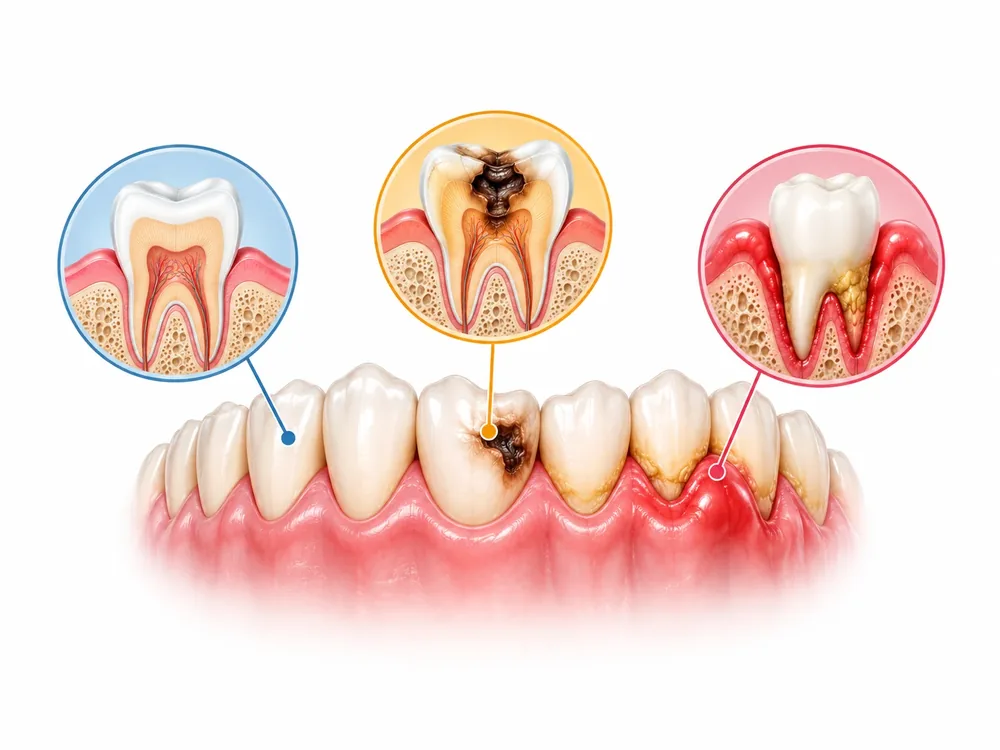
Cavities and tooth decay
Decay is a bacterial infection that slowly breaks down tooth enamel. About 1 in 5 adults ages 20 to 64 has a cavity that has not been treated [1]. Small cavities can be filled in one visit. Waiting can lead to deeper damage that needs a crown or root canal.
Gum disease
Gingivitis is the early, reversible stage, with red or bleeding gums. Left alone, it can become periodontitis, which damages the bone that holds teeth in place. About 42% of adults 30 and older have periodontitis [2], and gum disease is the most common cause of tooth loss in adults [7].
Tooth pain and infections
Deep decay or a cracked tooth can let bacteria reach the nerve, causing throbbing pain or an abscess. Your dentist may treat it with a root canal, a crown, or an extraction, and will tell you if antibiotics are also needed.
Broken, worn, or missing teeth
Crowns, bonding, bridges, and dentures restore teeth that are chipped, worn from grinding, or missing. Your dentist can also plan dental implants with an oral surgeon or periodontist.
Oral cancer screening
Your dentist checks your lips, tongue, cheeks, and throat at routine visits. An estimated 59,660 Americans were diagnosed with oral cancer in 2025 [5], and early findings are easier to treat.
Children's dental care
Half of children have had a cavity by age 9 [1]. Dentists use fluoride and sealants to protect young teeth and teach brushing habits that last.
Know your options
Common dental treatments explained
Knowing what a treatment involves makes it easier to say yes, or to ask the right questions. Your dentist will explain the options for your mouth.
Exam, cleaning, and X-rays
The base of preventive care. A hygienist removes plaque and tartar, the dentist checks every tooth and your gums, and X-rays find decay between teeth or below the gumline.
Fillings and sealants
Fillings repair cavities with tooth-colored material or metal. Sealants are thin coatings painted on back teeth, often for children, to keep decay from starting.
Root canal treatment
Removes infected or inflamed tissue from inside a tooth, then seals it. A root canal often saves a tooth that would otherwise need to come out, and is usually followed by a crown.
Crowns, bridges, and dentures
A crown covers and protects a weak or broken tooth. A bridge fills a gap using neighboring teeth. Dentures replace several or all teeth and can be full or partial.
Deep cleaning for gum disease
Scaling and root planing cleans below the gumline to remove bacteria and smooth tooth roots. It is the first step in treating periodontitis.
Cosmetic dentistry
Whitening, bonding, and veneers improve the color and shape of teeth. Ask your dentist which options suit your teeth and budget, and get the price before you start.
Before your appointment
What to expect at your first dental visit
A new-patient visit usually takes about an hour. If you are in pain, the dentist will focus on that first and plan the rest for later.
Health history.
You will go over medicines, health conditions, allergies, past dental work, and any pain or worries. Tell the team if you feel anxious, so they can go at your pace.
X-rays and exam.
X-rays are taken if needed, and the dentist checks each tooth, your gums, your bite, and the soft tissues of your mouth, including an oral cancer screening.
Cleaning.
A hygienist removes plaque and tartar and polishes your teeth. If you have gum disease, a deeper cleaning may be scheduled for another day.
Treatment plan and prices.
You leave with a clear list of what is needed now, what can wait, and the price of each item so you can plan.
Bring a photo ID, a list of medications (especially blood thinners and bone-strengthening drugs), recent dental X-rays if you have them, and your old dentist's contact details so records can be requested. If you have a heart condition or joint replacement, ask your doctor in advance whether you need antibiotics before dental work.
Make an informed choice
How to choose the right dentist near you
A good dentist explains your options clearly, respects your budget, and makes you comfortable enough to come back. Use this checklist.
- Confirm an active license. Dentists are licensed by their state board of dentistry, and you can look up any dentist on the board's website. Apptly Health verifies each dentist's license before listing.
- For specialist care, ask about specialty training. Dental specialists such as oral surgeons, periodontists, and orthodontists complete extra residency years, and some hold certification from a specialty board.
- Check that the services you need are offered, such as children's care, emergency visits, sedation, or cosmetic work.
- Ask for a written treatment plan with prices before any major work.
- Look at the price before you book. Self-pay patients also have a federal right to a Good Faith Estimate for scheduled care [6].
- Read the profile for languages, evening or weekend hours, and approach to anxious patients.
The evidence
The evidence: why regular dental care matters
Dental disease is common, mostly preventable, and costly when it is ignored. These figures come from the CDC and the National Institute of Dental and Craniofacial Research.
-
21%
of adults ages 20 to 64 have an untreated cavity
That is about 1 in 5 working-age adults [1].
-
42.2%
of adults 30 and older have periodontitis
The rate rises to 59.8% among adults 65 and older [2].
-
34 million
school hours are lost each year to emergency dental care
Unplanned dental care for children keeps them out of class [1].
-
$45 billion
in U.S. productivity is lost each year to untreated dental disease
Untreated problems lead to missed work and more costly care later [1].
Go deeper
Paying for dental care without insurance
Many adults pay for dental care out of pocket. A few habits help you get good care and keep costs predictable.
Prevention costs less than repair
A yearly exam and cleaning is usually the least expensive dental care you will buy. Catching a small cavity early can avoid a root canal and crown later.
Ask for a phased treatment plan
If you need several things done, ask your dentist to rank them by urgency. Infections and pain come first. Cosmetic work and replacing old but sound fillings can often wait.
Get prices in writing
Ask for a written estimate for each procedure before you agree to it. For scheduled care, self-pay patients have the right to a Good Faith Estimate, and a final bill that is $400 or more above it can be disputed [6].
Use your tax-advantaged accounts
HSA and FSA funds can usually be used for exams, cleanings, fillings, and other dental treatment. Purely cosmetic work such as whitening usually does not qualify.
Direct access compared
A clearer path to a dentist
| Consideration | Apptly Health | Traditional route |
|---|---|---|
| Choosing a dentist | Any listed dentist near you | Limited to your dental plan's network |
| Price | Visit price shown before you book | Often unclear until after treatment |
| Booking | Online in minutes | Phone calls during office hours |
| Annual plan maximums | No plan limits on the visit | Coverage can run out mid-year |
| Urgent tooth pain | Search open times near you | Call around for an opening |
Related care
Related specialists you can book
Your mouth is connected to the rest of your health. These Apptly Health specialists often work alongside dentists.
Helpful answers
Dentist FAQs
Do I need a referral to see a dentist?
No. General dentists are primary care for your mouth, so you can book directly on Apptly Health without a referral. If you need specialist care, such as wisdom tooth removal or advanced gum treatment, your dentist will tell you and can help you choose a specialist.
How much does a dentist visit cost without insurance?
Each dentist sets their own fees, and the visit price is shown on their Apptly Health profile before you book. X-rays, cleanings, and treatment such as fillings may be priced separately, so ask for a written estimate. Self-pay patients can also request a Good Faith Estimate for scheduled care.
Does Apptly Health bill my insurance?
No. Apptly Health is a direct-pay platform. You pay the dentist's listed fee directly, and Apptly Health does not submit claims to your insurance. Some plans reimburse out-of-network care, so check with your insurer if you plan to request reimbursement.
Can I book a dentist on Apptly Health if I have Medicare or Medicaid?
Check with the physician's office before you book. Medicare and Medicaid have rules that limit when an enrolled physician can accept direct payment for covered services, so whether a self-pay visit is possible depends on the physician and the service you need.
What is the difference between a dentist and an oral surgeon?
A general dentist handles checkups, cleanings, fillings, crowns, root canals, and simple extractions. An oral and maxillofacial surgeon is a dental specialist with four or more years of hospital surgical training who removes impacted wisdom teeth, places implants, and treats jaw and facial problems. Most people start with a general dentist.
Can I see a dentist virtually?
Some dentists offer video consults for advice on pain, swelling, a broken tooth, or a second opinion on a treatment plan. A video visit can help you decide how urgent a problem is, but exams, X-rays, cleanings, and treatment need to happen in the office.
What counts as a dental emergency?
A knocked-out adult tooth, severe pain, a broken tooth with sharp pain, or bleeding that will not stop needs a dentist right away. Spreading facial swelling, swelling with fever, or trouble breathing or swallowing needs an emergency room or 911, because a dental infection can spread.
How do I check that a dentist is licensed?
Dentists are licensed by their state dental board, not by a medical specialty board. You can search any dentist's name on your state board of dentistry website to confirm their license is active. Apptly Health verifies each dentist's license before their profile goes live.
What should I bring to my first dental appointment?
Bring a photo ID, a list of medications and allergies, recent dental X-rays if you have them, and your previous dentist's contact details. Write down any pain, sensitivity, or concerns. If you feel nervous about dental work, say so when you book so the team can plan for it.
How often should I see a dentist?
Many people do well with a checkup and cleaning every six to twelve months. If you have gum disease, a lot of fillings, diabetes, or a dry mouth, your dentist may recommend visits every three to four months. Your dentist will set the schedule that fits your risk.
When should my child first see a dentist?
Plan a first visit when the first tooth comes in, or by your child's first birthday. Early visits let the dentist check for decay, apply fluoride, and show you how to care for small teeth. Half of children have had a cavity by age 9, so early habits matter.
Can I use HSA or FSA funds for dental care?
In many cases, yes. Exams, cleanings, X-rays, fillings, crowns, root canals, dentures, and braces are generally qualified expenses. Teeth whitening and other purely cosmetic work usually are not. Check with your plan administrator to confirm before you book. Keep itemized receipts for each visit.
More questions about booking, payments, or your account? Visit the Apptly Health FAQ page.

For physicians
Are you a dentist?
Reach self-pay patients who are actively looking for dental care, set your own schedule and fees, and spend less time on dental plan paperwork.
Apply to Join the NetworkMedical review and references
Medically reviewed by Dr. Paula Muto
Board-certified vascular surgeon and founder of Apptly Health
This page is for general information and does not replace a consultation with a qualified physician. If you think you are having a medical emergency, call 911. If you are in emotional crisis, call or text 988.